A Retrospective On A Game That Does Not Exist
Doing retrospectives on games is honestly pretty easy. They tend to be immutable and, in the rare cases where they aren't, it's trivial to find a 1.0 or launch day copy floating around in the world wide web. In live-service games there's a tendency to neglect the introductory moments that allows me to hook myself into the relevant time period, or at the very least they're kind enough to annihilate the introduction entirely as a way to signify that, for example, New Warframe and Old Warframe are two different beasts.
But what do you do when the game in question occupies a middle-ground? Where it simultaneously exists unaltered yet irreparably changed in ways that make it something new?
I've been grappling with that for the last few months. Final Fantasy XIV is still playable, it's still live, and A Realm Reborn didn't go anywhere. It's still the introductory moments for any player onboarding themselves into the game, you still go through the dungeons and setpieces in the same order, and it still ends on a climax that Heavensward fails to properly resolve. Nothing has changed... Right?
Well, actually, a lot has changed. An uncomfortable amount. These changes are so miniscule that even today people think ARR has never been touched, yet paradoxically so obvious that I find them jarring. Even calling them miniscule feels reductive.
I'm perpetually surprised to find out that nu-XIV players (which, for my sanity, I am defining as people who joined up during or after Covid quarantine) consider ARR to be a boring slog. For many of them it's their first MMO, so there's a bit of context being lost: FFXIV actually bothering to sit you down and justify why you're doing the things you're doing, why you aren't immediately doing backflips on demigods, and why the gameplay gates keeping you from roaming is exceptional. Almost nobody in the MMO sphere was trying. In lieu of multi-layered systems or a four-pronged endgame loop or what have you, XIV's sell was that it thought its own world was pretty cool and it was much more interested in having you approach it from the ground up.
I have a theory as to why they're so bored by it though: They're doing it all at once.
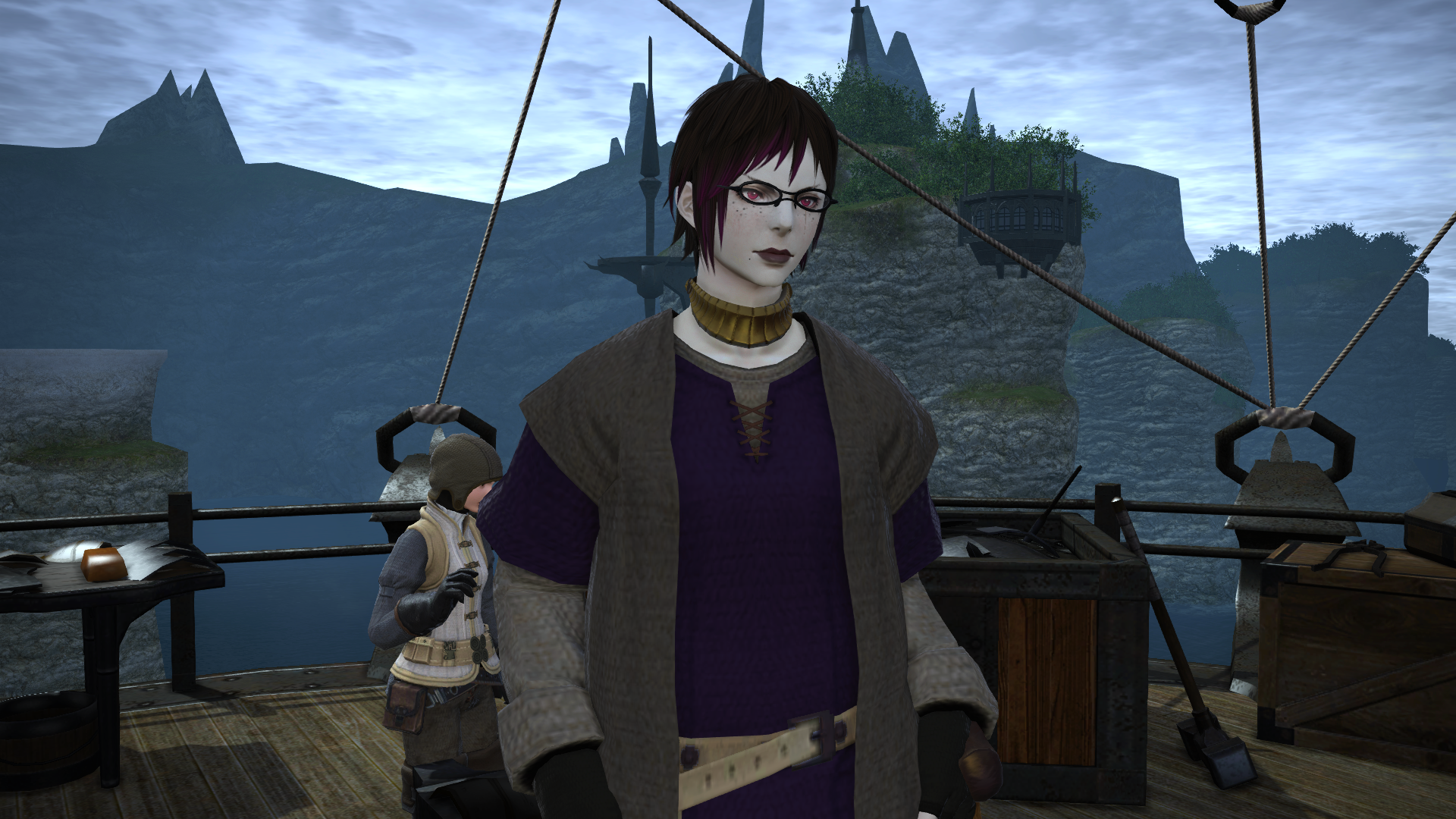
This image is older than some of my relatives, and every analog horror series that isn't Marble Hornets.
Something lost by incremental boosts to XP gain, the addition of gear coffers to keep you up to date, and the push to Be Current is that ARR is still, to this day, FFXIV's largest expansion. The intent of the experience was for you to hit an XP/gear wall or even just finish an arc thinking "wew, time for a break" and decide to do so by engaging in diversions. These diversions - crafting, gathering, other jobs and optional dungeons - are placed along the player's path in such a way that practically screams at you to try them out. When the game takes off the regional limiters and sends you straight towards the other starting cities, it's quite obviously guiding you to try out all the jobs there.
There's little reason to engage with this in the modern gamestate, however. Gear and XP are provided for, and even if you *do* get distracted it's not like crafting and gathering are things that take effort or even much in the way of time. With future expansions looming, as well as the promise of all those cool jobs and raid series' in them, why wouldn't you keep on trucking? This is something that becomes much more tangible if you spend some time with FFXI; the game's predecessor. ARR has a not-insubstantial amount of XI DNA in it - albeit nowhere near as much as 1.0 - and when viewed through this lens it's much easier to parse.
There's also the matter of the story itself. I know differing opinions exist and all but it's quite funny to see people posit that early XIV players must've been bored out of their mind until it "got good", when I and nearly everyone else who started while ARR was the totality of XIV were taken by the story existing at all. It's not exactly high art and isn't my favourite MSQ - that's 7.0 - but in an era where everything was succumbing to diet-Warcraft fantasy it was nice to play something with lower stakes. It was at times slow and plodding but it had a smaller cast of characters that it was keen to highlight whenever possible and, more importantly, bothered to focus on its world as something more than just an expository infodump. Sure, it had a lot of those infodumps, yet those were significantly less unwieldy than some of what comes after. It's 2026 and every expansion still opens with a two-branch exposition quest series where 3/4 of the runtime is unvoiced text telling you stuff that's so irrelevant it won't even make it into the next Encyclopedia Eorzea.
I've dogged on Naoki Yoshida and his cohort of writers for loving Matsuno's work but not really getting it; ARR is the closest they come to understanding the works they're a fan of. Eorzea are the "good guys" but they're also deeply corrupt ethnonationalists who hate one another and are ruled by systems of governance that, on a good day, exist to make money. Garlemald, not yet elevated to the status of Literally The Nazis by subsequent expansions, are trying to enforce the same kind of rule upon Eorzea that Eorzea itself is enforcing upon the """beast men""". It's not Tactics Ogre and it's not even FF12 but it's closer to either of those than future stories in the setting. And yes I include Stormblood in that; we can talk about it if I ever do a retrospective on THAT.
If you're a longtime XIV player you've likely noticed the elephant in the room, so let's address it: The cut quests honestly do more to harm the story than help it. Mechanically they were fetch quests, but something I liked about the ARR-era Warrior of Light compared to similar protagonists is that they were very clearly altruistic for reasons beyond mere self-interest or coin. The bulk of the cut quests are ones where they go above and beyond in being helpful with little justification other than "there is no reason not to". This hurts a number of arcs and even their silent characterization, but it takes a scythe to the Little Ala Mhigo and Doman Refugee arcs. These arcs, phenomenal at setting up the world and reinforcing the power structures of Eorzea, have been sliced down to the most frictionless size, ironically hurting the "better expansions" people rush towards because now your primary worldbuilding lead-in to Stormblood is slaughtered.
Tonally, though, I think the story suffers from the absence of The Warden Works in Mysterious Ways. An incredibly short quest consisting of talking to an NPC, interacting with a node, and talking again, I feel it's the quest that most deftly communicates that Eorzea is a quasi-post-apocalyptic setting and that it sucks. To summarize: After the vast majority of your allies are butchered and you carry their bodies into a cart, you arrive at their burial destination only to be told that there's no plots available; too many of you cohorts died, and they don't have enough space. Instead, they're to be buried alongside those who died in the Calamity. While not outright stated, the implication is that these are mass graves. One of the residing nuns senses that you're upset about this and urges you to make a prayer at a local waystone. You make the hike, say the prayer, and... Nothing. The roar of the rushing waters is punctuated by the faint chirping of vilekin and the shrill cries of a hawk. The gods, however, remain silent... This quest and its aftereffects are so potent that they're implicitly the reason why the WoL fumes when Gaius quizzes them on the Twelve's impotence.
'Eorzea sucks' is actually maybe the biggest thing that makes returning to ARR so jarring. Gridania is an ethnonationalist state that mostly gets by on pretending to be The Elemental's Chosen People while designating themselves as True Gridanians and designating the Duskwights and Keepers - who were there just as long as, if not longer than them - as 'others'. It is a region that has a serious bandit problem brought on by the state declaring two entire ethnic groups as second class citizens and driving them into poverty. Their internal police force has casus belli to do whatever they want to Duskwights and Keepers and whenever this is challenged the response boils down to "Well, the Elementals say it's okay, so fuck off".
Limsa Lominsa is a boneheaded meritocracy formed by a bunch of pirate crews whose governance system is "whoever's strongest can do what they want", which stems from the nation's founding amidst a mountain of Sahagin and Kobold corpses. Despite seeming the "least bad" of the big three, it's an apathetic and self-centered nation that cares so little about people in its borders that it'll send crews to kill slavers but not actually free slaves; because slavers are bad for business, first and foremost.
Ul'dah, hypercapitalism in its purest form, openly wears its corruption on its sleeve and has an economy primarily built around subjugating anything around them, forcefully or economically. It's somehow more openly racist than Gridania in part due to its penchant for exploiting the demographics it hates. While the other city states at least pay lip service to the idea of having a fair system for choosing rulers, Ul'dah makes no attempt to hide that everyone involved in ruling it wants to hold onto power for as long as possible, suffering be damned. Side content in ARR alone also highlights that Ul'dah did chemical warfare against the other major faction in Thanalan - Sil'dih - and ended up exterminating nearly everyone there.
Ishgard, perpetually off-screen in this expansion, is a hyper-misogynistic theocracy which instead masks its corruption by instead giving the Inquisition free reign to kill, exile or silence anyone who'd talk about it. Somehow more classist than all of the above, it's a deeply misogynistic hellhole - to the point of having prisons that're literally more than holes to throw women into - that one character considers so bad, she considers all the suffering she had to endure to be worth it because at least it got her out of Ishgard.
And the recently fallen Ala Mhigo, also off-screen, is stated repeatedly to have been a formerly imperialist power who used its immense national pride to stoke the flames of war and constantly bully its neighbours, which it did right up until a bigger kid entered the playground and kicked them in the dick.
All of this remains true going forward, but while ARR establishes all of these as problems, subsequent content treats them as either footnotes, stuff to be discussed in minor side content, or set dressing. The idea that someone could drop Merlwyb and just radically change the landscape of Limsa hangs over ARR, but never manifests. The Seedseers being corrupt and admitting to lying about the Elementals being able to talk to them is all-but-discarded in later content, with Kan-e-Senna getting a loathsome introspection arc that skips over this before culminating in a scene where "the people of Gridania" - comically lacking in Keepers or Duskwights among the nameless populace - come together to help her. ARR postpatch comes so close to mixing up Ul'dah's status quo only for the most contemptible mini-arc in the game to pop up in Heavensward to completely defang and sidestep it. Almost all of Ishgard's problems are ignored in HW, pinned on the pope, and implied to be over. Ala Mhigo's history is relegated to Bard quests and some crafter stories. Garlemald just become The Nazis outright - complete with death camps - which makes them so ludicrously evil that any bad things Eorzea does are utterly banal in comparison. Even the Ascians, initially implied to be working to stop the planet's aetheric balance collapsing before Shadowbringers retconned all of their motives and behaviours, aren't immune. So while you can 'go back' to ARR, you can't go back to a world where any of this was meant to mean anything.

TP, and many of these skills, haven't been in the game for years.
ARR is part of FFXIV, and XIV is a videogame, so while all of that is pertinent, I can't say it's as important as the fact that XIV's design ethos was completely different in 2013-2015. TP, acting much like MP, acted as a limiter on melee classes endlessly freestyling and made sprinting a tactical decision that meant trading your ability to act for a movement speed increase. More importantly, though, the level cap was 50. 50 was 'current', it was endgame, and thus the player was getting new tools and skills at a fairly even rate, with the expansion's climax being geared around players with their full, unrestrained toolkits. Since then, however, the level cap has risen, and the gap between a fully-functioning moveset and a half-complete series of disparate buttons grows ever wider - though the devs promise to fix this in Evercold. In ludic terms, the game hypes you up for the confrontation with Baelsar and Lahabrea but is still very visibly wearing the training wheels. It's still another 40 levels before you get the full moveset, sorry kiddo. This, alongside free flight in ARR zones, sprinting because completely safe due to being free (and thus removing the risks associated with mob aggro for melee classes) and a whole host of other changes, essentially means that what was once a full expansion with a designated "early game" has now become the entirety of FFXIV's "early game". Which would be fine were it not significantly longer than any other expansion while feeling markedly emptier due to everything we've discussed.
So, yeah, I get why newer players aren't as taken by ARR. Doubly so because the game was already kinda vast and overwhelming at launch, let alone now where you're expected to sprint - not walk - towards the 'current content'. Even the best of us will miss things.
But that's not why I'm writing this post. No. I'm writing this post because I don't really know how to handle the fact that I can't review ARR. I'm in the middle of a replay, about where the aforementioned Warden quest would've been, and it's been a struggle to even write review notes. ARR is still here, I can still play it, but it's so phenomenally far away from me that I feel like I'm walking through a dead mall. One of those dead malls where the food court is still open and there's a supermarket, so despite 3/4 of it being a ghost town, there's still people going through it, passing by, or whatever. I initially wrote my own woes as anxieties about getting old but... You know, that just feels incongruous with everything else about me. Modern Warframe doesn't stoke that feeling in me even though I started playing it a few months prior to XIV and was on that train for 7 years.
Hmm. Mentioning Warframe actually squared the circle for me. See, Warframe is very very upfront about how much it's not like Old Warframe. The old star map, starting locations et al have been completely excised and revamped into a new form. The old bosses got total top-to-bottom reworks, planets that were once "the corpus ship but off-green" now have fully bespoke tilesets, and enemies no longer use Tenno weapons. So on, so forth, repeat for 13 years. FFXIV, meanwhile, has a "business as usual" cadence that makes it very mum about any actual changes. The massive sweeping rework to the Free Trial occupies significantly less space on the patch notes compared to, say, the addition of a separate slot for glasses/visors or any changes to housing. So I suppose you could sum it up like this: The dissonance between FFXIV (and the creatives involved) treating itself as a congruous work with a straight line from A-B-C-D-E-F-G, and the incredible amount of changes they've made that've massively impacted past parts of the experience. The patch notes for the ARR rework call it a "smoother" journey through MSQ, but all they really did was expedite it haphazardously. It's ultimately a harsher version of the problem that comes with reviewing a live service game that's visibly spinning its wheels for later patches. I reviewed Zenless Zone Zero back on Backloggd but there was really no point; that was a 1.0 release for a game that's proudly boasting it'll drop the rest later.
Of course this is ultimately par for the course. Despite a cloying fanbase who buy into every assertion that later reveals were all planned and done with intentionality, the game's history is littered with developers and writers alike admitting that they finalized key plot beats only a few months out from an expansion release, or sudden pivots that they did incredibly late. Like, he's never said it outright, but it's obvious that Yoshida and everyone involved was kinda sick of having to follow a blueprint set up by what amounts to a functionally different dev team. And I, in turn, sit here frustrated at the random u-turns of a game I like but would be better served by quitting. Will I? I have no idea. I think everyone who's into games has at least one toxic squeeze that they don't really love that much and would be better off splitting from it. XIV is mine.
And boy, sometimes I wish I wasn't.